


Our Location
Kastro Hill Villas is located in the settlement of Plagia of the Municipality of Akti-Vonitsa, which, although located in the opposite Acarnania, is the closest village to the city of Lefkada. The wider area to which our village belongs is the “Plagia Peninsula”. It is the area that connects it to the Acarnania mainland by the land part.
It which begins from the so-called “Cleopatra Canal” (at the entrance to the village of Agios Nikolaos as we come from Lefkada) and, leaving Lake Voulkaria to the east, meets the Ionian Sea in the Gulf of Paleros.”Plateau Peninsula” was apparently named because the lands of Plaia occupy a very large part of it, almost 50,000 acres. It is obvious that the people of Plaia managed, sometimes using the law of the fist, to “conquer” a large part of the peninsula.
Geographical Information

The Plagia Peninsula
This area opposite Lefkada is depicted on almost all old maps of Lefkada during the Venetian era as “terra ferma” or “terra ottomana”. And this depiction is proof that Lefkada and Plagia are not just geographically adjacent but that they form a unity, despite their different political fates, as had also been proven in antiquity, especially in Hellenistic times, when both areas belonged to the “Community of Acarnanians”.
Plagia Settlement & Diavlos
Aerial photograph of the new settlement of Plagia and the Diavlos, which separates Lefkada from the Plagia Peninsula. At the top of the hill, above the village, the castle of Agios Georgios built by Ali Pasha in 1807.
The first written evidence of the existence of a village in the area with the name “Plagia” dates back to the years of Turkish rule, in the 16th century, and specifically to the year 1530/31.

Before 1684 and for the period 1479-1684, Lefkada was the only one of the Ionian Islands that was under Ottoman rule, like the entire Greek territory. At this time, Lefkada, together with the land opposite, up to Angelokastro, constituted a large administrative region, the “sanjak of Karleli”. The Turkish archives preserve the tax lists compiled by the Ottoman administration of those times for the various regions of the Ottoman Empire, and, among them, the tax lists of the sanjak of Karleli, which included Lefkada and Plagia.
This very recent archival source gives us important information about our village and sheds some light on a period of its history, about which there was darkness until now: firstly, that a settlement with the name “Plagia” has existed at least since the beginning of the 16th century; secondly, that the name has remained the same since then; thirdly, it records its population during these years; and fourthly, it preserves for us a list of its inhabitants by name for the year 1641-42.
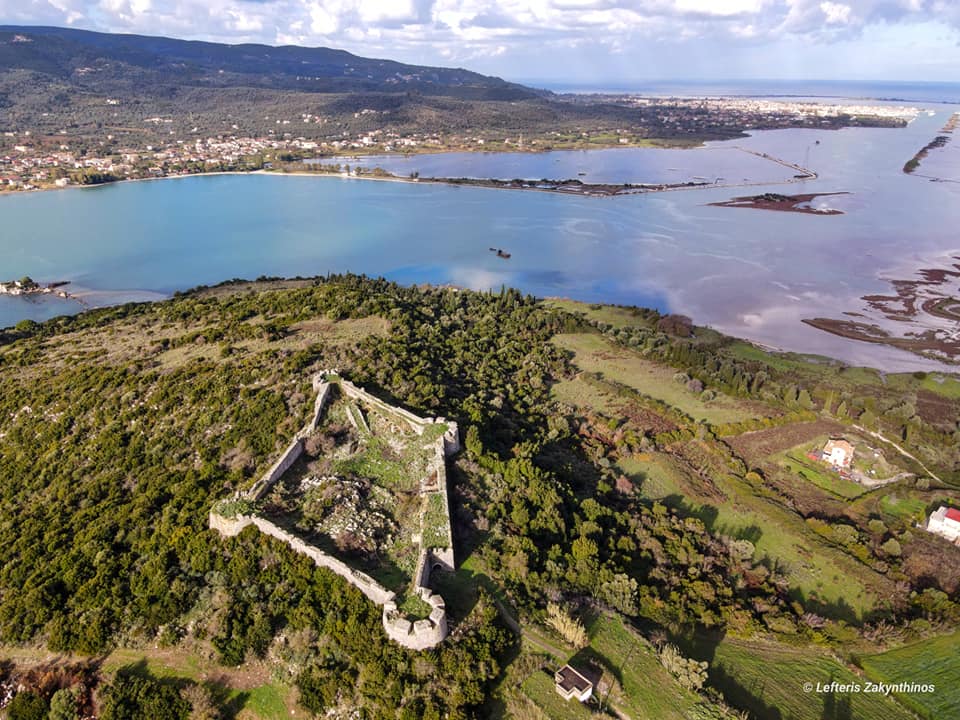
Fort of Sant George
The fortress of Agios Georgios built by Ali Pasha in 1807, when he was preparing an invasion to conquer Lefkada. To the west of the fortress, Professor Nikos Faraklas places the ancient Sollion and Dailperdos the Nirikos of classical times.
Lefkada has been under Venetian rule since 1684. Since the Ionian Islands were under Venetian rule, unlike our own region, which was under Ottoman rule, it had a well-organized administration and archives. The archives of Lefkada, therefore, contain a lot of information about the opposite land. There are also notarial archives, which contain a treasure trove of information for the aspiring researcher. The oldest testimony that we have traced is dated 30.05.1692 (a contract contained in the protocol of the notary of Agia Mavra, Georgios Tzermptani), in which a group of people from the surrounding villages appears, tasked with determining the borders of the village.
Until 1998, our village was a separate community, the “Community of Plagia”, which had been founded under Venizelos in 1912. With “Kapodistrias” (Law 2539/1997) it was incorporated into the “Municipality of Kecropia” (which was renamed the Municipality of Paleros) and with “Kallikratis” (Law 3852/2010) into the “Municipality of Aktion-Vonitsa”.
Our settlement was moved to its current location “Kastro” in 1976 from “Palia Plagia”.
Palia Plagia
The central part of the village with the church of Agios Dimitrios and (behind it) the Primary School.
